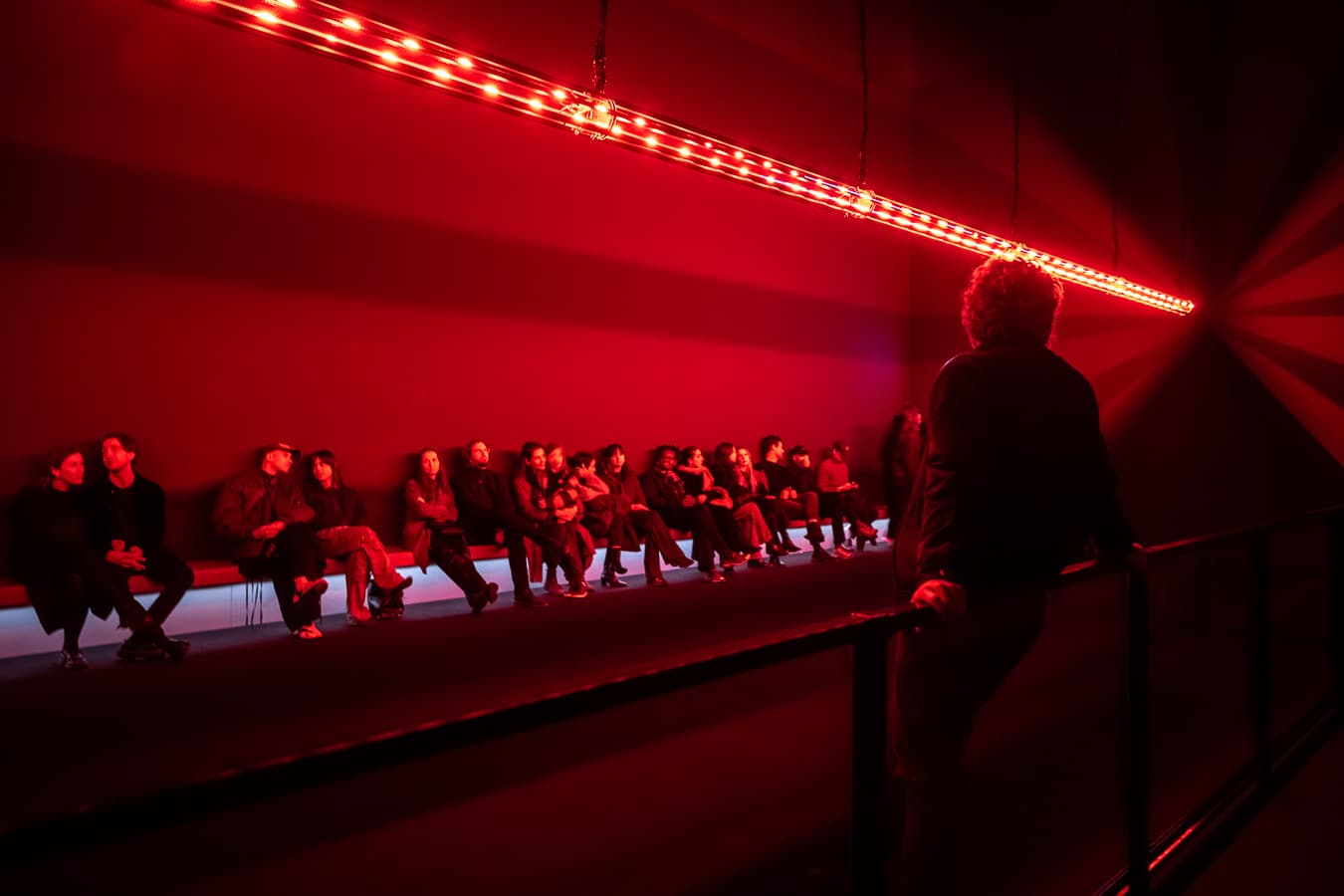
Lumus Instruments is an Amsterdam-based studio creating physical manifestations of computational technology through light, sound, and structural elements. Led by Timo Lejeune and Julius Oosting, their multidisciplinary approach blends design, architecture, and engineering. Through repeating experiments, they refine digital systems while investigating their impact on how we perceive and interact with space and time. We sat down for an interview with Timo Lejeune to talk about Lumus Instruments’ creative process, motivations, and work on show at Nxt Museum, POLYNODE XI.
Nxt: What is POLYNODE XI?
TIMO: POLYNODE XI is an audio-visual installation. It’s the eleventh iteration of our series of POLYNODEs. It is a ever-evolving project where we create various shapes using digital nodes. It’s a long modular installation where we use nodes as points to generate sound and light in various positions in the room. Our main goal is to create a spatial multi-speaker instrument:
We approach it as an instrument in order to play with it.
We wanted to see what we could create with a very simple mechanism. We wanted to create a complex, living feeling in an installation. Throughout the years, we’ve tried various shapes and types of content. At Nxt Museum, we also had a different version of POLYNODE than we’re currently working on. This is what we really like to do with these works: to use them as an evolving piece that is forever changing and evolving into something new, making it feel more like the living entity we wanted to create.

Your work POLYNODE XI, previously POLYNODE VIII is part of an ongoing artist residency at Nxt Museum. Can you tell us about the evolution of the work from its previous iteration to its current state?
We took a significant step between POLYNODE VIII and XI, which was triggered by both the installation we have at Nxt and a new installation called POLYNODE Cycles: a circular installation that we are currently exhibiting in Houston, which was also featured at the Wire Festival in New York. We created a whole new system for it and reworked how the nodes respond. We optimised everything to make it easier for us to explore various computing-intensive processes, but a significant change is the audio engine.
The biggest difference between the works is the software, which is the beating heart of the installation. Now we have programmed all of the audio in SuperCollider instead of everything coming from TouchDesigner. We collaborated with Max Frimout on this, and this sound adds a whole new layer to the installation.
POLYNODE XI comprises three chapters, and the last chapter was something we particularly wanted to do, inspired by the work of Gabey Tjon a Tham (whose artwork, Red Horizon, shares the room with our own installation). Her work consists of chaotic oscillators, sine LFOs (Low Frequency Oscillators) that interfere with each other. If you examine the installation at Nxt, in the final chapter, it also features eight of these LFOs moving to mimic Gabey’s installation.
The composition is a journey towards that kind of behaviour where the installation slowly goes from very simple forms to chaotic, and the harmony of these sine waves essentially mimics Gabey’s installation. We wanted a movement and a feeling that would complement her installation, before it starts up again. You feel that both works were inspired by each other.
I think the two artworks are saying a lot to each other. I don’t know if we can express their emotion in our natural language, and the sounds that they currently make are what I really like about Gabey’s work. Her sounds feel very organic; you really feel like the installation itself is making them. I think, and I hope, that people also feel this with our installation.
What do you want your viewers to feel when they experience POLYNODE XI?
POLYNODE XI envisions a future of harmony between humans and technology. Its behaviour is designed to feel organic and intuitive, inviting interaction. The work doesn’t aim for one emotion, but simply offers room to reflect.

What are some of the inspirations behind your work?
I once read Critical Path by Buckminster Fuller. I think that was the book that shifted my way of thinking the most. Fuller is an architect and industrial designer, but he did most of his work from the ‘40s to the ‘60s. And he did a lot to use less material and think of ways to work better with the environment. The solutions he devised to address those kinds of issues were just so beautiful on their own.
That kind of philosophy, which involves how you think and how you implement ideas into something physical, I think, is really beautiful, particularly in the kinds of things that Buckminster Fuller developed. I think it’s really inspiring.
In our work, we strive to achieve a similar goal. This is what I like the most, purely from an engineering point of view: creating something that implements a certain solution in a remarkably elegant way, allowing you to interact with it. That is the most important thing. And that is what we continually try to develop in various forms for various types of lights.
For example, we have a prototype for a new kind of light fixture that we’re working on. It still needs some generations before it has the same kind of flexibility and playfulness as our other systems. Right now, it doesn’t look playful. But when we design with it in mind and conceptualise things with it, it just makes us really happy, imagining all the things we can do with it. And it just never stops. Right now we’ve been working with this material for three years, and still, we’re coming up with new ideas.
When we talk about playfulness, we’re talking about the space of possibility. It’s also one of the first things that we always do when we have interns. We give them an element and encourage them to explore everything that they can do with it. We really helped them understand how they can have something that is both simple and diverse.

While your work is exhibited at Nxt Museum you’re also working on many different projects for festivals and nightlife venues. How do these two worlds complement each other?
I think you have different kinds of challenges, and you work with different kinds of methods at festival environments. The work of Boris Acket is a particularly good example of the use of this layer-like structure and LED screens. It’s the use of festival methods to create something new.
Working at festivals and clubs has challenged us to employ a methodology that asks: how do you create something on a large scale while still maintaining a relatively low production cost? That’s what festivals are generally optimised for, and it was what gave us the possibility to grow and improve ourselves and the things that we made.
Our installations weren’t invented in one week or not even in one year, you know. It was years of trying to make something that barely works and almost looks nice, and then growing that into something more functional. And then, having that break down thirty times before you come up with something that looks aesthetically pleasing and keeps working. I think the festival industry is a perfect breeding ground for trying things like that and developing them. It’s forgiving in a sense that you can make mistakes a little more, so it serves an important function also for young artists to try and develop themselves.
How do you program differently for the two environments?
In festivals, the only way to make yourself and your art stand out, and to give people a unique experience, is to do something different from what the stages are already doing, from an experiential point of view. It’s quite a challenge, because you have so little control over your environment. In that sense, it is also a very difficult environment to start with, but at the same time, you are allowed to try and make mistakes. It’s like a challenging playground. You can’t wish for a better place to try things.
At festivals, the biggest challenge is always the sound and the light. Very few festivals go deep into the night or even all the way through the night, so a lot of times you’re setting up for something that has an hour of darkness, for example, and without the smoke. I think you can still create the coolest experiences where you have control over both. But this is not the case at festivals. There, we’re mostly exploring the shape and how we can create an atmosphere. At museums, you can really tell a story. You can really go from very tiny and detailed things happening, building up to a very maximalist explosion. And these kinds of arcs are just not possible to achieve with an installation at a festival.
Categories:
Artist Bytes
Date:
25 November 2025