
NEDERLANDS
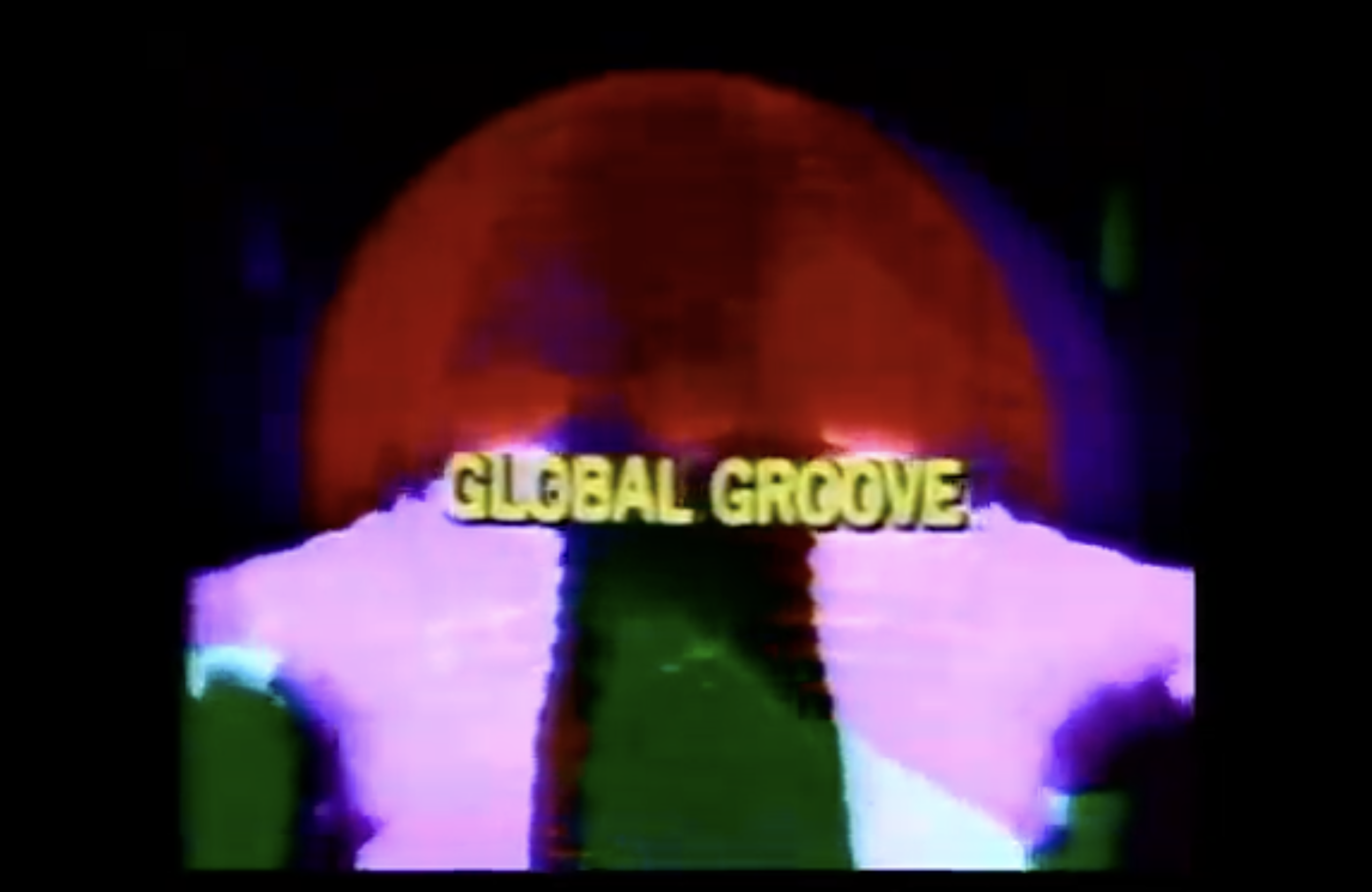
Nam June Paik, Global Groove, 1973, video, 28’51’’
(fragment: 0’00’’–2’00’’; 15’14’’–18’30’’; 21’42’’–23’45’’)
De video Global Groove is een kleurrijke verkenning van video en inmiddels een iconisch werk van een van de grote pioniers van dit nieuwe medium: Nam June Paik (1932–2006). Hij behoort tot de eerste kunstenaars die de impact van televisie op zowel de kunsten als de maatschappij voorziet. De openingszin van het werk is veelzeggend en toont Paiks vooruitziende blik: “This is a glimpse of a videolandscape of tomorrow, where you will be able to switch to any station of the earth and TV guides will be as fat as the Manhattan telephone book.” In het werk wisselen vormexperimenten, popmuziek, boeddhistische rituelen, reclames en interviews met bekenden en collega’s van de maker – onder wie Allen Ginsberg, John Cage en Charlotte Moorman – elkaar in razend tempo af, in een tijd waarin zappen op televisie nog een gloednieuw fenomeen is.
ENGLISH
Nam June Paik, Global Groove, 1973, video, 28’51’’
(except: 00’00’’–02’00’’; 15’14’’–18’30’’; 21’42’’–23’45’’)
A colourful exploration of video, Global Groove is regarded as an iconic work by one of the great pioneers of the medium, Nam June Paik (1932–2006). Paik was among the first artists to foresee the impact of television on both the arts and society. The opening line of his work is telling, demonstrating Paik’s foresight: “This is a glimpse of the video landscape of tomorrow, where you will be able to switch to any station on earth and TV guides will be as thick as the Manhattan telephone book.” The video sees formal experiments, pop music, Buddhist rituals, adverts, and interviews with the artist’s acquaintances – including Allen Ginsberg, John Cage, and Charlotte Moorman – alternate at breakneck speed, at a time when channel-hopping on television was a brand-new phenomenon.

NEDERLANDS
SERVAAS, News Resonance, 1981, video, 02’56’’
SERVAAS (1950–2001) onderzoekt in zijn werk de impact van televisie als massamedium en de artistieke potentie ervan, met bijzondere aandacht voor de relatie tussen beeld en geluid. Veel van zijn werken zijn visuele gedichten, gebaseerd op nieuw materiaal. Ook in News Resonance gebruikt hij bestaand nieuws als uitgangspunt. De kunstenaar neemt de karakteristieke pieptonen van het radionieuws van de BBC World Service als basis voor een ritmische compositie. Woorden die een eindeloze stroom aan verontrustende gebeurtenissen beschrijven, verliezen hun oorspronkelijke betekenis. Hun impact wordt lichamelijk voelbaar gemaakt. Meer dan veertig jaar later blijft het werk verrassend actueel. Het nieuws dendert voort, net als de geopolitieke onrust. Welke rol kan een videokunstenaar hierin spelen?
ENGLISH
SERVAAS, News Resonance, 1981, video, 02’56’’
With his work, SERVAAS (1950–2001) explored the impact of television as a mass medium, as well as its artistic potential. Paying close attention to the relationship between image and sound, many of his works take shape as visual poems, based on material from the news cycle. In News Resonance, SERVAAS uses existing news reports as his starting point. The artist takes the characteristic beep tones from BBC World Service radio broadcasts as the basis for a rhythmic composition. Meanwhile, words describing an endless stream of disturbing events lose their original meaning: their impact is made physically palpable. More than forty years on, the work remains surprisingly topical. The news rolls on, as does the geopolitical turmoil – but what role can a video artist play in conversations such as thee?

NEDERLANDS
Tom Klinkowstein, 3 Artist On-Line On Slow-Scan-TV, 1980, video, 15’09’’
(fragment: 0’00’’–04’49’’)
In 1980 schrijft de in Nederland woonachtige kunstenaar Tom Klinkowstein (1950) geschiedenis met een live-uitwisseling via televisie tussen verschillende locaties in de wereld: op 9 juni om 10.00 uur in Amsterdam, 16.00 uur in Cambridge (Verenigde Staten) en 13.00 uur op Pender Island (Canada). Videobeelden worden omgezet in geluid en vervolgens via de telefoon verzonden. Elke geluidstoon vertegenwoordigt één beeldpunt op het slow-scan-scherm dat voor iedere deelnemer staat opgesteld. Een Robot 530 zet de ontvangen geluiden weer om in beeld. Deze video vormt een verslag van wat er die dag in de drie studio’s gebeurt. Het werk doet denken aan een voorloper van Good Morning, Mr. Orwell van Nam June Paik uit 1984: de eerste internationale videokunst installatie en live televisie-uitzending die gelijktijdig op verschillende plekken in de wereld plaatsvindt via satellietverbinding.
ENGLISH
Tom Klinkowstein, 3 Artist On-Line On Slow-Scan-TV, 1980, video, 15’09’’
(except: 0’00’’–04’49’’)
On 9 June 1980, the Netherlands-based artist Tom Klinkowstein (b. 1950) made history with a live television exchange between different locations around the world: at 10.00 pm in Amsterdam, 4.00 pm in Cambridge (United States), and 1.00 pm on Pender Island (Canada). Video images were converted into sound, then transmitted via the telephone. Each sound tone represented a single pixel on the slow-scan screen set up in front of each participant. A Robot 530 converted the received sounds back into images. This video serves as a record of what took place across the three studios that day. The work can be considered as a precursor to Nam June Paik’s Good Morning, Mr. Orwell from 1984: the first video art installation and live television broadcast to take place simultaneously in different locations around the world via satellite link.
Categories:
Exhibition text
Date:
11 June 2026